Understanding Florida’s Partial Denial for 1% Matching Language: What It Really Covers — And What It Doesn’t
Florida’s matching statute and the 1% of Coverage A limitation have become one of the most misapplied provisions in property insurance claims. Carriers frequently use the 1% cap as a catch‑all excuse to underpay flooring claims, cabinet claims, and any situation involving continuous materials. But the endorsement is far narrower than most insurers suggest.
This article breaks down exactly what the 1% matching rule applies to, what it does not apply to, and why homeowners should never accept a carrier’s blanket denial of removal, underlayment, or access work.
What is the 1% Matching Rule?
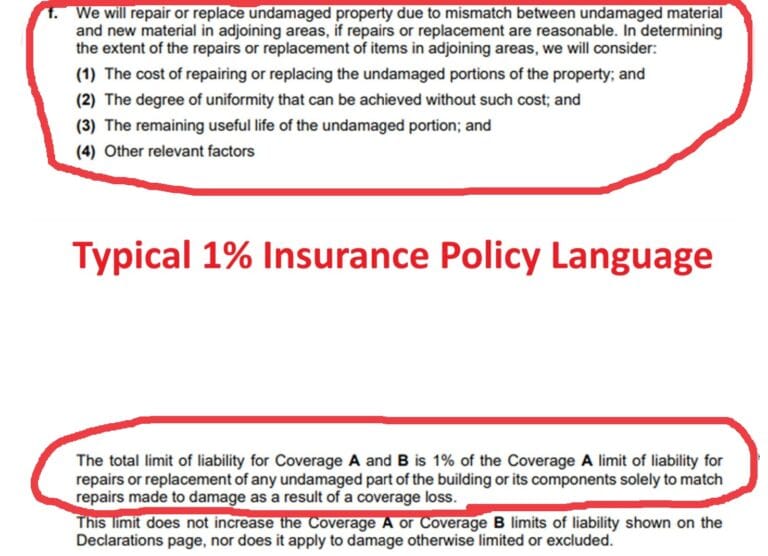
The language simply states that the policy limits the coverage of “undamaged” but “Matching” materials to 1% of Coverage A on your policy. So, look at the declarations page of your homeowners insurance policy. How much coverage do you see listed under Coverage A? To figure out how much coverage the 1% limit will give you, just multiply the amount you see under Coverage A by 1%. For example, lets say you have $470,000 of coverage under coverage A, this means you have a limit of $4700 in coverage for “undamaged but matching” material. The rule can be a little confusing. Visit us at www.AllstarAdjusting.com. Call us at 954.659.8333. We are happy to help explain it to you.
Is the 1% Matching Language guided by Florida Statute?
Not that I can find. It appears to be policy language or an endorsement that regulators approved.
The Statute vs. Policy Endorsement
- Florida’s Matching Statute (Fla. Stat. § 626.9744): Requires insurers to make reasonable repairs or replacements in adjoining areas if replaced items do not match undamaged items in color, quality, or size. The statute itself does not contain a 1% cap or sublimit.
- The 1% Cap: This is added through specific policy endorsements approved by the Florida Office of Insurance Regulation. These endorsements limit how much a carrier has to pay for replacing undamaged property solely for matching purposes to 1% of the Coverage A limit.
What the 1% Matching Rule Actually Covers
The 1% matching limitation applies only to:
“Replacement” of undamaged finished materials
Replaced solely for the purpose of achieving uniform appearance.
That’s it.
If a material is undamaged, and the only reason it is being replaced is because it must match the repaired area, then the cost of replacing that undamaged material is subject to the 1% cap.
Examples of items that can fall under the cap:
Undamaged tile
Undamaged laminate or vinyl planks
Undamaged carpet
Undamaged baseboards
Undamaged paint
Undamaged cabinets (only when replaced for matching, not removed for access)
The key is replacement for matching, not removal, not access, not substrate work, and not collateral damage.
What the 1% Matching Rule Does NOT Apply To
Insurance carriers hope you don’t understand the following:
1. Removal of Undamaged Materials
Removal is part of the repair process. It is labor, not matching. There is a clear difference between matching of materials and the removal of matierals.
Examples:
Removing continuous flooring to reach damaged sections
Removing tile to access cracked or water‑damaged areas
Removing cabinets that sit on top of continuous flooring
Removing carpet and pad to access damaged subfloor
Removal is fully covered. It is not subject to the 1% cap.
2. Collateral Damage Created During Removal
When bonded or continuous materials are removed, collateral damage is unavoidable — and fully covered.
Examples:
Thinset tearing up the slab
Underlayment ripping
Tile fracturing during removal
Adhesive delaminating
Concrete needing scraping or leveling
- Detaching and resetting baseboards or replacing baseboards.
Collateral damage = new damage caused during a covered repair. New damage is covered, not capped.
3. Underlayment, Thinset, Adhesives, Leveling, and Substrate Prep
Matching endorsements apply only to visible finished materials, not installation components.
Fully covered items include:
Thinset
Mortar
Underlayment
Moisture barriers
Sound‑proofing mats
Concrete scraping
Floor leveling
Subfloor repair
These are required to reinstall the flooring — and are not subject to the matching limit.
4. Items That Must Be Removed for Access (Cabinets, Islands, Vanities, Appliances)
If a cabinet sits on top of continuous flooring, it must be removed to access the damaged area.
This is access work, not matching.
Access work is fully covered.
Flooring: The Best Example of How the Rule Works
Flooring is the most common area where carriers misapply the matching limit.
When flooring is continuous:
The damaged area is fully covered.
Undamaged continuous flooring is subject to the 1% cap only for replacement, not removal.
All removal labor is fully covered.
All underlayment, thinset, leveling, and substrate prep are fully covered.
Any cabinets sitting on the flooring must be removed — fully covered.
Special installation patterns (diagonal tile, herringbone, staggered):
These patterns require:
Full‑area scraping
Concrete cleaning
Leveling
Pattern‑specific reinstallation
These are installation requirements, not matching items. They are fully covered.
Why This Matters for Homeowners
Carriers often try to apply the 1% limit to:
Removal
Labor
Underlayment
Thinset
Subfloor prep
Cabinets
Collateral damage
None of these fall under the matching endorsement.
When adjusters allow carriers to apply the cap broadly, homeowners lose thousands of dollars in legitimate coverage.
Understanding the rule — and enforcing it correctly — ensures the insured receives the full repair they are entitled to.
Where the 1% Rule Limits Your Coverage:
When an insurance carrier applies the 1% cap to your claim, you should know that the 1% includes ALL “other” areas of matching, also. For example, let’s say you have 2 or more separate areas of damage to your house. Once you hit your 1% limit (the example above references $4700), then the other areas will have zero dollars in coverage if those other areas have undamaged but matching material. Yes, you still have coverage for the actual damaged material, but you don’t have any coverage left for the undamaged but matching portion. In other words, your 1% limit applies to the entire claim.
Bottom Line
The 1% matching limit applies only to the replacement of undamaged finished materials.
It does not apply to:
Removal
Labor
Underlayment
Thinset
Subfloor prep
Collateral damage
Cabinets or items in the way
Any required access work
When flooring is continuous, the carrier must pay:
Full removal
Full substrate prep
Full reinstallation
Full access work
Replacement of damaged materials
Replacement of undamaged materials up to the 1% cap
The 1% Matching Restriction in Conclusion:
In the end, the 1% matching rule is narrow in scope but broad in impact. It applies only to the replacement of undamaged finished materials, yet once that 1% limit is exhausted, every other area of undamaged but matching material in the claim is left without coverage. Homeowners still retain full coverage for damaged materials, removal, access work, underlayment, substrate prep, and collateral damage — but the matching portion of the claim stops the moment the 1% cap is reached. Understanding this distinction is critical: the rule limits appearance‑based replacement, not the labor or materials required to perform a proper repair. When adjusters enforce the endorsement correctly, homeowners receive the full scope of repairs they’re owed, while carriers are prevented from using the 1% cap as a blanket denial tool.
This is certainly a very frustrating insurance denial. Call our office. We may be able to assist. Visit us at www.AllstarAdjusting.com. Call us at 954.659.8333.